
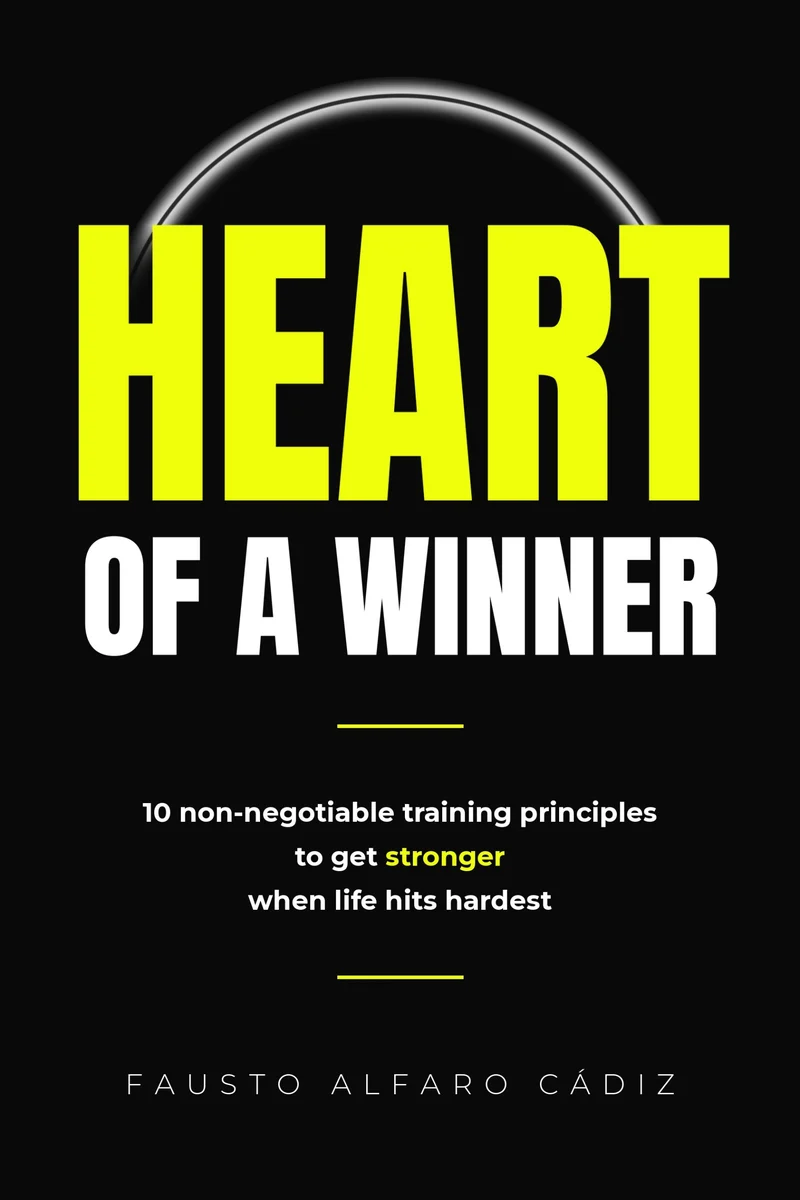
Heart of a Winner
10 Non-Negotiable Training Principles to Get Stronger When Life Hits Hardest. What coaches use to prepare elite athletes, applied to your work, your relationships, your habits and the moments when life hits hardest.
Problems will never disappear. We need to learn to live while they exist.
For a long time we tell ourselves that someday everything will be in order, and then we’ll finally start. That day doesn’t exist. Life is like a laundry hamper: the moment you empty it, it starts filling up again.
“Heart of a Winner” doesn’t ask you to think positive while you ignore what’s in front of you. It gives you a system that has been used for decades to transform human performance: ten principles that explain why we improve, why we stall, why we slide backward and why the same plan doesn’t work for everyone.
Each chapter combines one principle, two stories of elite athletes and concrete practices so you can turn theory into change that survives real life.
The 10 principles
One principle of sports training per chapter, applied to your life, with two athletes who explain it better than any theory.
- 01
Functional Unity
Simone Biles and Andrés Iniesta
What happens in one area of your life trains with you in all the others.
- 02
Individualization
Michael Johnson and Muhammad Ali
The best plan starts from who you are today, not from what worked for someone else.
- 03
Specificity
Kobe Bryant and Andre Agassi
You get better at what you practice, so train the real situation.
- 04
Overload
Javier Sotomayor and Sarah Reinertsen
A bar set a little higher: not so low it doesn’t move you, not so high it breaks you.
- 05
Variability
Eliud Kipchoge and Stephen Curry
Changing one condition on purpose forces you to grow.
- 06
Recovery
Rafael Nadal and Adam Peaty
You improve while you rest. Without recovery, effort is just wear and tear.
- 07
Periodization
Roger Federer and Usain Bolt
One priority per stage, and everything else on maintenance.
- 08
Reversibility
Michael Jordan and George Foreman
What you stop practicing fades, and what you repeat builds you.
- 09
Supercompensation
Michael Phelps and Carolina Marín
After the blow, if you recover well, you come back stronger.
- 10
Continuity
Jamie Vardy, Jimmy Butler and Gabby Douglas
The one who wins is the one who keeps going when no one is watching.
Excerpts in the author’s voice
Some of the deepest ideas in the book, to listen to on a walk or before bed. Here are three; all eleven are on the audio page, with transcripts.
Don’t Wait for the Hamper to Be Empty
For a long time, we tell ourselves that someday we’ll reach a stage when everything is in order. We’ll have settled the problems that are still pending, and we’ll finally have the time we lack right now. Then we’ll be able to get to the things we’ve been putting off for months or years: taking care of ourselves, starting that project, training regularly, or finally making the decision that never finds its moment. I’m sorry to tell you this, but that day doesn’t exist. Life is a lot like a laundry hamper. You can run a load, hang it up to dry, fold every item, and put it all away. For a few minutes you’ll feel like you’re finished. But while you celebrate the small victory of having everything washed and put away, you head to the shower, take off the clothes you were wearing, and realize the hamper is no longer empty. The laundry piles up again because you keep on living. Problems work the same way. There will always be something waiting: an unexpected expense, or a loss that wasn’t part of our plans. Sometimes the problems will be small, but other times life will hit us with a force we don’t feel ready for.
Fausto Alfaro’s voice, recreated with artificial intelligence from his own voice. Text taken from the book, unchanged.
The first pages
The full introduction of “Heart of a Winner”, exactly as it appears in the book. Read it here or turn it page by page, like paper.
Introduction
✦ ✦ ✦Don’t Wait for the Hamper to Be Empty
For a long time, we tell ourselves that someday we’ll reach a stage when everything is in order. We’ll have settled the problems that are still pending, and we’ll finally have the time we lack right now. Then we’ll be able to get to the things we’ve been putting off for months or years: taking care of ourselves, starting that project, training regularly, or finally making the decision that never finds its moment. I’m sorry to tell you this, but that day doesn’t exist.
Life is a lot like a laundry hamper. You can run a load, hang it up to dry, fold every item, and put it all away. For a few minutes you’ll feel like you’re finished. But while you celebrate the small victory of having everything washed and put away, you head to the shower, take off the clothes you were wearing, and realize the hamper is no longer empty. The laundry piles up again because you keep on living.
Problems work the same way. There will always be something waiting: an unexpected expense, or a loss that wasn’t part of our plans. Sometimes the problems will be small, but other times life will hit us with a force we don’t feel ready for. If we wait for everything to go away before we begin, we’ll spend our lives preparing for a calm that never arrives.
“Problems will never disappear. We need to learn to live while they exist.”
Learning to move forward under those conditions is the starting point of this book. Nobody can give you a formula for making everything turn out right, and I’m not going to ask you to think positive while you ignore what’s in front of you. I’m no fan of simplistic positive psychology. What you’ll find here is something more useful: a system for understanding how change happens and what you can do to build an improvement that survives the mistakes of real life.
That system already exists, and it has been used for decades to transform human performance. Coaches apply it when they prepare someone to run faster or to compete under pressure. Its ten principles explain why a body improves, why it stalls, why it slides backward, and why not everyone responds the same way to the same plan.
My proposal is to apply those ten principles outside the gym as well. Done well, they can help us understand why some strategies work for a while and why others stall. You’ll see why trying harder doesn’t always mean getting better results if that work isn’t heading in the right direction. You’ll also learn what makes some mistakes sink us and others teach us. Once you understand these principles, you’ll start to see them everywhere, and the way you look at your own problems will never be quite the same. This book will give you tools to train your life the way you’d train a physical body, and to direct your effort better in every area you want to develop.
Knowing What to Do Is Rarely the Problem
We live surrounded by information. Whatever you want to improve, you can find thousands of tips in a matter of seconds. Some will be good and some will be useless, but a lack of information rarely explains why we don’t change our habits. Most of us know far more than we put into practice.
We know sleep is important, and yet we go to bed staring at a screen. We know we should save, but when a raise comes in, it’s easy to turn it into new expenses. We have more advice than we need. What we lack is an understanding of the process and the ability to apply it correctly.
Imagine someone walking into a gym for the first time and trying to train their whole body with the heaviest weight they can move. Nobody with experience would call that discipline. We’d say they haven’t understood how training works. Outside the gym, though, we often admire that very same behavior. We applaud the person who never stops and keeps their calendar packed. We confuse being busy with moving forward, and then we’re surprised when that person ends up with psychological problems, or gets frustrated at not getting the life they were trying to improve. This book wants to help you stop wasting the effort you put in every day that isn’t paying off. And we’ll do it without adding more pressure to the pressure you already carry.
Training a Life
You can’t avoid training your life. Life trains us even when we haven’t chosen the program. Every schedule we keep and every decision we repeat leaves behind an adaptation. If we don’t decide where we want to head, those inertias will choose part of the path for us, and they can take us somewhere we don’t want to go. When we step in on purpose and choose the right training program for our life, we can adjust the process and direct our effort better.
“Your life trains you even when you haven’t consciously chosen the training program.”
The ten principles work like a map. They help you tell movement from direction, and choose your path better when obstacles appear. So when the mountains come, and they certainly will, the principles will help you decide whether to climb them or go around because you’ve realized they lead somewhere you no longer want to go.
Anyone Can Use This System
Books about success tend to fill up with exceptional people. This book will also contain stories of great athletes and brilliant figures in their fields, because sport pushes human principles to extremes and lets us observe them clearly. We’ll see athletes who trained for years to compete for seconds, and others who retired, came back, changed environments, or faced the judgment of millions of people.
Your goal may be something more everyday, like regaining your health or changing a behavior that has been hurting you for years. Those transformations can completely change the footing from which you’ll live the next ten or twenty years.
Applying these principles requires observing honestly what you do and adjusting when necessary. Reading this book will help you recognize patterns that until now looked like isolated events. You’ll identify when a load is making you better and when it’s only wearing you down, and you’ll also recognize why change becomes much harder when your environment doesn’t support it.
If you apply what you’re about to read, you’ll make better decisions. You’ll also begin to understand what kind of person you’re training with those same decisions you repeat day after day. That’s why we’ll answer a question that will almost certainly change your life: Who am I becoming while I try to get what I want?
Start Before You’re Ready
Maybe you opened this book during a season of change. Or maybe you’ve been thinking for a while that you should do something different with your life, even though you’re not yet sure what. Maybe you’re tired of starting over and always ending up back at the same point. If so, don’t worry: you don’t need to figure everything out before moving on. I’ll show you the way.
In fact, one of the traps we’ll look at is waiting to understand every detail before taking the first step toward the change you’ve longed for. The mind knows how to disguise fear as prudence. Sometimes it tells us we’re not good enough, and other times it says we could do it whenever we wanted, so there’s no need to start today. And when the project looks complex, it demands a perfect plan that never quite gets ready. Plans are carried out first and perfected along the way. I’ll explain how to do that properly later on.
This book will follow that principle too. It’s written by someone who, like everyone, has problems and situations to resolve. I write from my own experience of teaching others and making mistakes while I try to understand these processes. Many of the ideas you’ll find here changed as I tried to live them, and they’ll keep changing, because I will, too. That’s exactly why I want to walk through the process with you.
There will be moments when you recognize something you already knew. Don’t rush past them, because knowing an idea and living by it are different things. Other pages will sting, because they’ll show you something you don’t like about yourself. Don’t turn that discomfort into guilt. Use it as information.
Don’t try to change ten things at once while you read. The ten principles I’m going to show you are very powerful. Pick one, and make a change small enough that you can repeat it and important enough to produce a response. At the end of each chapter, we’ll go over a brief summary of the main ideas, and above all I’ll give you concrete practices to apply what you’ve learned to your life. My obsession is turning theory into practice, so don’t settle for just reading. Come back to the book as many times as you need, and use it as a manual.
This is the end of the introduction. The ten principles are waiting for you in the book.
Don’t just read it. Train it.
Join the free Readers’ Club and get the 24-page workbook with the exercises for every principle, the audio excerpts and the book app before anyone else.
Fausto Alfaro Cádiz
Science communicator, university lecturer and personal trainer for more than 20 years. He holds a degree in Physical Activity and Sport Sciences and a master’s in sports performance and health, and teaches sports management at the Universitat Politècnica de València.
In “Heart of a Winner” he takes the principles used to prepare elite athletes and applies them to what happens to all of us off the field: work, relationships, habits and the moments when life squeezes hardest.
About the book
What is “Heart of a Winner” about?
It is a personal growth book. It takes the 10 principles coaches use to prepare elite athletes and applies them to everyday life: work, relationships, habits, setbacks and change.
Is it a sports book?
No. Sport is the lens, not the topic. The stories of 20 elite athletes, from Rafael Nadal to Simone Biles, help explain ideas you can use whether or not you ever train.
Who is it for?
For anyone who knows what they should change but keeps getting stuck, and for anyone going through a hard season who wants a practical system instead of empty motivation.
What formats are available?
Paperback, hardcover and Kindle, all on Amazon.
Is there a free workbook?
Yes. Members of the free Readers’ Club get the 24-page “Heart of a Winner” workbook with the practical exercises for every principle.
Is it a translation?
Yes. It was first published in Spanish as “Alma de vencedor” (2026) and has been translated into English.
Links to Amazon.com.