
Listen to Heart of a Winner in the author’s voice
Eleven excerpts from the book to listen to while walking, training or before bed. The deepest ideas about getting stronger when life hits hardest, narrated in my voice.
One idea for every hard moment
Start with the introduction or go straight to the principle that speaks to you right now. Below the player you’ll find the full transcript of each excerpt if you’d rather read it.
Don’t Wait for the Hamper to Be Empty
For a long time, we tell ourselves that someday we’ll reach a stage when everything is in order. We’ll have settled the problems that are still pending, and we’ll finally have the time we lack right now. Then we’ll be able to get to the things we’ve been putting off for months or years: taking care of ourselves, starting that project, training regularly, or finally making the decision that never finds its moment. I’m sorry to tell you this, but that day doesn’t exist. Life is a lot like a laundry hamper. You can run a load, hang it up to dry, fold every item, and put it all away. For a few minutes you’ll feel like you’re finished. But while you celebrate the small victory of having everything washed and put away, you head to the shower, take off the clothes you were wearing, and realize the hamper is no longer empty. The laundry piles up again because you keep on living. Problems work the same way. There will always be something waiting: an unexpected expense, or a loss that wasn’t part of our plans. Sometimes the problems will be small, but other times life will hit us with a force we don’t feel ready for.
Fausto Alfaro’s voice, recreated with artificial intelligence from his own voice. Text taken from the book, unchanged.
Transcripts
Introduction · Don’t Wait for the Hamper to Be Empty
For a long time, we tell ourselves that someday we’ll reach a stage when everything is in order. We’ll have settled the problems that are still pending, and we’ll finally have the time we lack right now. Then we’ll be able to get to the things we’ve been putting off for months or years: taking care of ourselves, starting that project, training regularly, or finally making the decision that never finds its moment. I’m sorry to tell you this, but that day doesn’t exist. Life is a lot like a laundry hamper. You can run a load, hang it up to dry, fold every item, and put it all away. For a few minutes you’ll feel like you’re finished. But while you celebrate the small victory of having everything washed and put away, you head to the shower, take off the clothes you were wearing, and realize the hamper is no longer empty. The laundry piles up again because you keep on living. Problems work the same way. There will always be something waiting: an unexpected expense, or a loss that wasn’t part of our plans. Sometimes the problems will be small, but other times life will hit us with a force we don’t feel ready for.
Excerpt from “Heart of a Winner” by Fausto Alfaro Cádiz.
Principle 1 · Functional Unity · What Worries You Also Trains With You
A worry doesn’t need to occupy all your thoughts to affect your life. It can stay in the background, like an app left open on your phone that drains the battery even when you aren’t looking at it. Before a difficult conversation, the body can stay tense for hours. When we anticipate a problem, we mentally replay scenes that haven’t happened yet. We sleep worse and have less patience for things we’d normally tolerate. That’s why, in periods of stress, we don’t just feel worse; we can also decide worse. This doesn’t mean all our decisions are determined by emotions, or that there’s nothing we can do about them. We do have the ability to learn to recognize them, step back, and respond differently, with more composure. But it’s absurd to design a plan as if those emotions weren’t part of the person who will have to carry it out. Think about the last time you snapped at someone over something small. The apparent reason may have been a sentence or a simple gesture, and yet the force of your reaction probably also belonged to everything that had happened before. The argument started at eight in the evening, but part of it had been building since eight in the morning.
Excerpt from “Heart of a Winner” by Fausto Alfaro Cádiz.
Principle 2 · Individualization · The Pace You Need to Train At
Individualization forces you to stop asking what the perfect plan is and start asking what plan you can carry out today. If you haven’t exercised in years, your first win is finding two weekly sessions that don’t bore you and that you won’t abandon when a bad moment comes. If you decide to start writing and you have one free hour a day, maybe you can move forward with a system built around that longer session. But if you only have twenty minutes between responsibilities, your system has to respect that reality and fit that time. Writing for twenty minutes can even be more serious than writing for an hour, because it’s the only system with a chance of being repeated over the medium and long term. You also have to individualize the timing. Some people think better early in the morning; others need the house to quiet down at night. Some need to announce a deadline publicly in order to finish a task, because that social pressure works for them, while others freeze if they feel everyone is watching. Some people need to train with company so they won’t skip sessions, and others concentrate better alone. None of these ways is better than the others, but all of them give you information for designing your process better.
Excerpt from “Heart of a Winner” by Fausto Alfaro Cádiz.
Principle 3 · Specificity · Values Are Trained Too
Values also need a specific behavior. Honesty is trained by telling the truth when lying would be easier. Self-respect takes shape when we set healthy limits with others and accept that the other person may not take it well. The same is true of every other value. We need to identify the behavior that expresses it and specifically practice the person we want to be in the future.
Excerpt from “Heart of a Winner” by Fausto Alfaro Cádiz.
Principle 4 · Overload · Your Life Has Bars to Clear Too
The problem is that, outside of sports, almost no one sets the bar. We can spend months believing we want to improve while we repeat tasks that no longer cost us anything, answer the same emails, or act the same way without ever setting limits with others. Repeating a task we’ve already mastered for a long time can maintain our ability, but it will hardly make it advance. When you do the same thing over and over without setting yourself any challenges, you can feel busy, but don’t fool yourself: your capacity stays right where it was.
Excerpt from “Heart of a Winner” by Fausto Alfaro Cádiz.
Principle 5 · Variability · The Response That Got You Here
Each of us has built a small repertoire of responses to pressure, and almost all of them have a history that justifies them, because there was a moment when they worked for us. Think of a man who started his professional career in a basic technical position. Whenever something went sideways, he stayed an hour later and pulled it off through his own effort. That earned him a reputation, and over the years he was promoted to lead a team of eight people. Today, when a problem comes up, he does the same thing: he stays late and solves it himself. Only now the problem is a team that isn’t learning because he corrects everything, and a calendar that leaves him less time to think every month. His old response has stopped serving him, and the natural temptation is to apply it with more intensity and more control. That’s where variability can help, because it isn’t necessarily about trying harder, but about practicing a different response to the same kind of problem. Instead of doing everything himself, he can delegate to someone on the team to present a result that isn’t yet perfect and discuss afterward what to improve, or he could reserve one morning a week to think instead of putting out fires. The first few times he’ll feel clumsy and even irresponsible, because he’s practicing a version of himself he hasn’t yet mastered, but that feeling is the sign that he’s training something new.
Excerpt from “Heart of a Winner” by Fausto Alfaro Cádiz.
Principle 6 · Recovery · Resting Isn’t the Same as Switching Off
Imagine a Sunday afternoon after an exhausting week. You lie down on the couch with your phone and start scrolling through videos. When you look up, two hours have gone by. You haven’t done anything. Technically, you’ve rested, and yet you feel worse than before, foggier, with the sense that the weekend has slipped away from you. That stretch of time distracted you, but it didn’t restore you. What makes a break restorative is that your mind stops processing stimuli nonstop and can let go of the worries it’s carrying. Everyone has their own sources of recovery, and individualization appears again here. Some people recharge by walking alone; others through a conversation with someone they trust, cooking without hurry, working out, or reading something that has nothing to do with their job. What matters is learning to tell the difference: some activities give you energy back, others take it away, and others simply fill the time and leave you the same. It’s the same with people. We all know someone who leaves us lighter after an hour of conversation, and someone who leaves us drained for the rest of the day after a single meal together. Cutting out of your life everyone who asks something of you would be a mistake, because the relationships that matter also cost energy. So what’s useful is knowing what happens to you with each one, and deciding more carefully how much time you can give them and in what way.
Excerpt from “Heart of a Winner” by Fausto Alfaro Cádiz.
Principle 7 · Periodization · All Your Project Needs Is to Have Started
All your project needs is to have started and to be in the right phase. I’ve known very intelligent people, with far more education than I have in certain subjects, who have spent years designing a business or a project that never gets off the ground. Their plan gets more and more detailed, but further and further from reality. And I’ve seen others with less initial knowledge who started, made mistakes, corrected, and today have gone much further. Notice that in these cases the difference between the two wasn’t talent. It’s that some stayed forever in the preseason, and the others dared to compete, even if it was in a small league.
Excerpt from “Heart of a Winner” by Fausto Alfaro Cádiz.
Principle 8 · Reversibility · What You Do When No One Is Watching
There’s a hidden form of detraining that I’ve been able to observe throughout my professional career: the detraining of standards. Many people work carefully when the boss is in front of them or when they know someone important is going to see the result, but the rest of the time they lower the bar. The problem is that a standard practiced only when there’s an audience gets detrained in private, and most of our life happens in private. Every time you do something well that no one will check, you reinforce the idea that you’re someone who does things well. Every time you do it badly because no one will see, you’re also training an identity, just a very different one. You’re either training yourself or detraining yourself; there’s no middle ground, so you decide.
Excerpt from “Heart of a Winner” by Fausto Alfaro Cádiz.
Principle 9 · Supercompensation · When to Take the Next Step
Outside of sports, no one marks on the calendar when the next stimulus should arrive. That’s why you have to learn to read it yourself. Some people finish an enormous project and, without taking a breath, begin another. They do it out of fear of losing momentum or because stopping makes them nervous. For a while it seems to work, until one day they discover they’ve been performing below their level for months without understanding why. They’re in the low part of the curve, piling fatigue upon fatigue. There are other people who, after achieving something that cost them a lot, relax so much that it takes them a year to take the next step. When they finally do, the confidence they’d gained has evaporated, and they feel like they’re starting from zero. They took too long to expose themselves to a new stimulus that would make them improve. There’s no formula for knowing the right moment, and be wary of anyone who gives you an exact number, but there are signals that help. You can bring back the three checks we saw with overload: the next challenge has to demand effort from you, give you information, and let you repeat it. And you can add one more question: Have I recovered? If you feel eager again and what used to look like a mountain now seems manageable, you’re probably at the high part of the curve, and it’s a good time to challenge yourself again.
Excerpt from “Heart of a Winner” by Fausto Alfaro Cádiz.
Principle 10 · Continuity · The Freshly Painted Car
When you drive a freshly painted car off the lot, it’s easy to become obsessed with keeping it from getting even one scratch. You park it far from the others, and the first scratch feels like a knife in your own side, but with time you understand that marks are going to appear. What matters is taking care of the car and repairing whatever needs repairing without living in fear that it won’t be perfect. Something similar happens with new habits. At first we want an impeccable streak, and the first lapse seems like a catastrophe. “I’ve already ruined it,” we think, and we give up. What ruins it is turning a lapse into the start of quitting. But the metaphor also has another side, and in my opinion it’s far more important. That a scratch can be repaired doesn’t mean it doesn’t matter if you wreck the car. Some damage leaves a mark forever, and some behaviors can’t be fixed by a good intention the next day. Continuity sits halfway between obsession with perfection and neglect. You keep the habit, you accept small lapses, you repair them quickly, and you don’t allow yourself major breakdowns.
Excerpt from “Heart of a Winner” by Fausto Alfaro Cádiz.
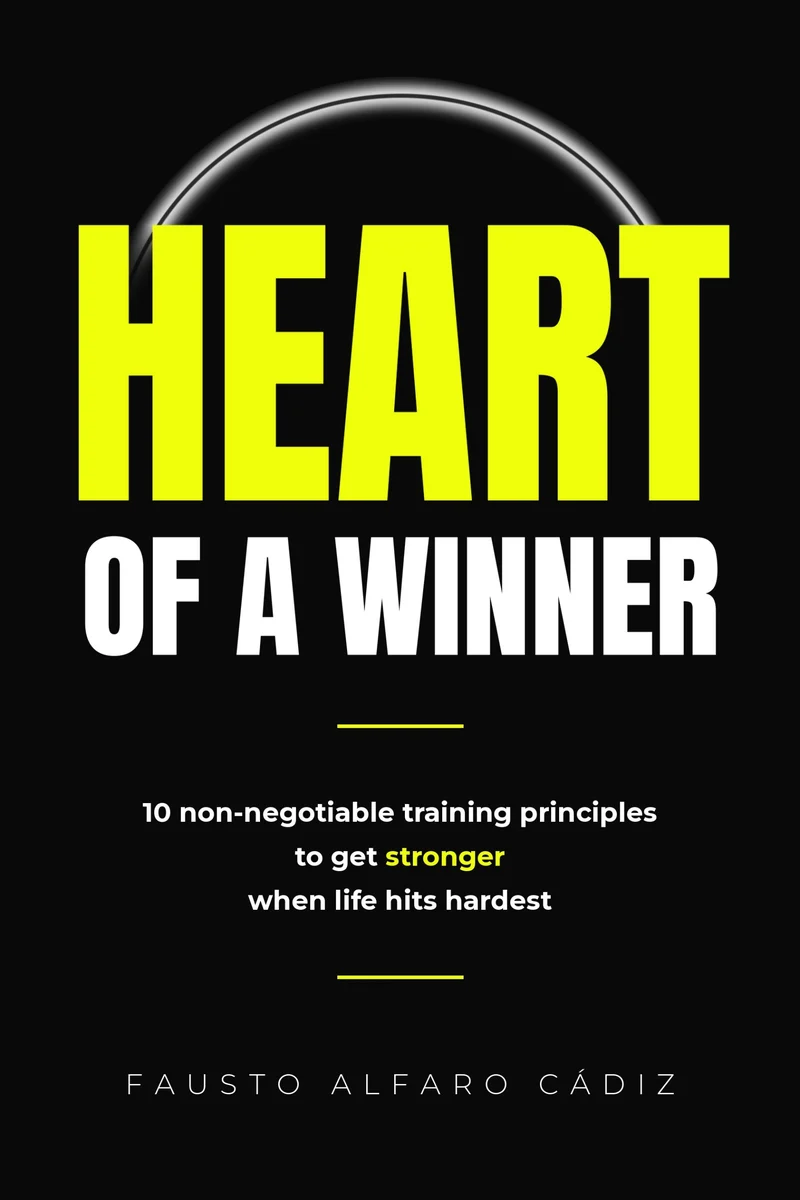
10 Non-Negotiable Training Principles to Get Stronger When Life Hits Hardest
“Heart of a Winner” takes the principles used to prepare elite athletes and applies them to what happens to all of us off the field: work, relationships, habits and the moments when life squeezes hardest. These excerpts are just a taste.
Want more?
Join the Readers’ Club and get a welcome gift, the workbook for the 10 principles and new audio before anyone else.
About the audio
What are these audio excerpts?
Eleven excerpts from “Heart of a Winner”: the introduction and a reflective passage from each of the 10 principles. The text is exactly as it appears in the book.
Who narrates them?
They are narrated with my voice, recreated with artificial intelligence from my own recordings. That way I can share excerpts of the book without you having to wait for a full audiobook.
Are they free?
Yes. You can listen here as often as you like, no sign-up needed.
Will there be a full audiobook?
If there is, members of the Readers’ Club will be the first to know.
Where can I read the full book?
“Heart of a Winner” is on Amazon in paperback, hardcover and Kindle.